Future Trends
Part V tested the book's argument against practice, and Chapter 21 distilled what works today. Part VI turns to what comes next. This chapter looks at the developments most likely to reshape AI governance over the next five years, as an analytical outlook rather than a forecast. Each section separates what can be observed today, with sources, from what can be expected and from what is speculation, and the chapter ends with a horizon register that puts the outlook under version control.
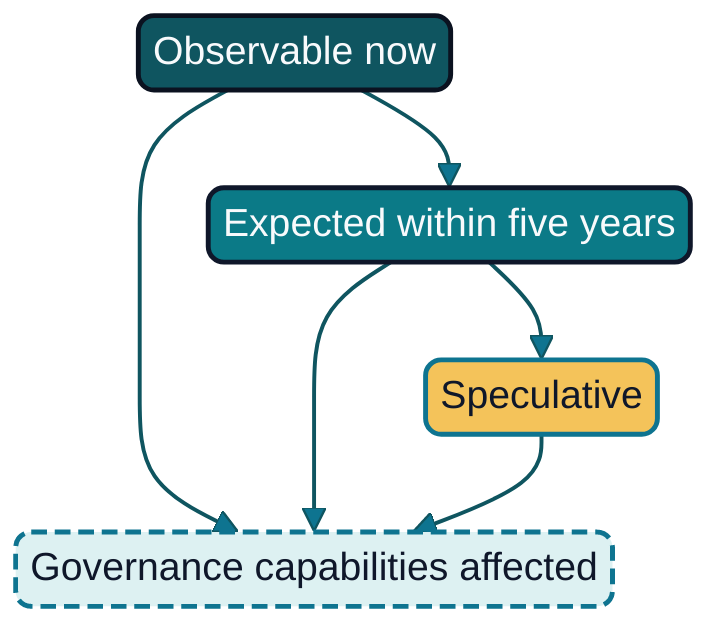
Figure 22.1: The horizon map places each governance trend by the confidence with which it can be stated. The table below links each trend to the capability it affects.
| Horizon | Trend | Capability affected |
|---|---|---|
| Observable now | AI Act phases on fixed dates | Obligation mapping and overlays as code |
| Observable now | GPAI Code and Article 50 guidelines | Classification policy and triggers |
| Observable now | First harmonised standard cited | Evidence store and exit plans |
| Expected within five years | Final Article 6 guidelines | Classification policy and triggers |
| Expected within five years | EEA incorporation of the AI Act | Obligation mapping and overlays as code |
| Expected within five years | Supervisors expect inventory and evidence | Decision tiers and decision records |
| Expected within five years | Accountability for each grant of agency | Decision tiers and decision records |
| Expected within five years | Periodic sovereignty reviews | Evidence store and exit plans |
| Speculative | Code-based supervision | Evidence store and exit plans |
| Speculative | Agents acting across organisations | Decision tiers and decision records |
| Speculative | Further AI Act simplification | Obligation mapping and overlays as code |
Table for Figure 22.1: Trends by horizon and the capability they affect.
Reading an outlook responsibly
This chapter borrows the architecture radar practice of Architecture as Code (Chapter 25) (66, Nordqvist, 2025): state each trend, classify the evidence, assign a horizon, name the decision it affects, and set a review date. Three horizons are used. Observable covers developments already visible in adopted legislation, published guidance, cited standards or production systems; expected covers developments with strong evidence but uncertain timing or form within five years; and speculation covers developments that are plausible and consequential but not yet evidenced.
The labels matter because a governance arrangement built on a speculative trend should be reversible, while one built on an observable trend may be committed to. A date in adopted legislation is observable, but a date in a Commission proposal is not, as the Digital Omnibus showed when the co-legislators replaced the Commission's proposed mechanism with fixed dates. The author's own projections, which go further than the evidence, are kept for Chapter 24 (Reflections on Each Part).
The AI Act's remaining phases
Observable. Chapter 3 traces how the AI Act, Regulation (EU) 2024/1689 (1, European Union, 2024), has come into application under Article 113, and how the Digital Omnibus on AI, Regulation (EU) 2026/1744 (27, European Union, 2026), replaced the proposal to link the high-risk obligations to the availability of standards with fixed dates. The prohibitions, the AI literacy duty and the general-purpose AI obligations apply, as do the Article 50 transparency obligations since 2 August 2026, although providers whose systems were already on the market have until 2 December 2026 to comply with the marking obligation of Article 50(2). The Omnibus also moved the Article 57 deadline for national regulatory sandboxes to 2 August 2027. Three dates therefore dominate the next two years: 2 August 2027 for legacy general-purpose AI models and national sandboxes, 2 December 2027 for Annex III high-risk systems, and 2 August 2028 for high-risk systems embedded in regulated products. Verify the current timeline before committing a programme plan to any of them.
Expected within five years. The first enforcement cases for high-risk systems will concentrate on documentation, registration and human oversight, the obligations easiest to verify from outside, and the Commission will use Article 7 to adjust the Annex III list at least once. The response is the same either way: keep the obligation mapping of Appendix A under version control and let the pipeline evaluate controls against it.
Speculation. The Digital Omnibus showed that the co-legislators will reopen the AI Act when implementation lags, and a second round could narrow the high-risk scope or adjust deployer duties. If it happens, the cost falls on organisations that froze their programmes waiting for it, because the controls the AI Act requires are, for the most part, those good governance would require anyway.
Guidelines, codes of practice and standards
The AI Act relies on a second layer of instruments to make it applicable, and that layer is arriving late, in stages, and often after the obligations it explains.
Observable. The General-Purpose AI Code of Practice (14, European Commission, 2025), published in July 2025, gives model providers a voluntary route to demonstrating compliance with their transparency, copyright and safety obligations. The Commission's guidelines on the Article 50 transparency obligations appeared in July 2026 (195, European Commission, 2026), shortly before those obligations applied, while the guidelines on classifying high-risk AI systems under Article 6, due in February 2026, had appeared only as a draft for consultation in May 2026 (196, European Commission, 2026). In October 2026 the first of them, EN 18286 on quality management systems, was cited in the Official Journal, giving providers a route to a presumption of conformity for the requirements of Article 17, whereas the standards on risk management, data governance, transparency, human oversight, accuracy and robustness were still in progress (194, CEN-CENELEC, 2026).
Expected within five years. The final Article 6 guidelines and most harmonised standards will arrive before the Annex III obligations apply, but some close to the date. Organisations that built on ISO/IEC 42001 (32, ISO/IEC, 2023) and kept the mapping from control to clause as data, as Chapter 9 recommended, will change the mapping rather than the controls. Codes of practice will multiply, and each will need an owner who decides whether the organisation adheres to it.
Speculation. Harmonised standards may become the de facto governance specification for high-risk AI systems in Europe, as ISO/IEC 27001 did for security management, and conformity assessment may move towards a continuous, evidence-based process closer to the pipeline model of Chapter 11.
Enforcement and supervisory expectations
Supervisory expectations for AI are converging on governance, inventory and evidence, well before the AI Act's high-risk obligations apply.
Observable. In October 2026 the Commission stated that the AI Office had begun enforcing the general-purpose AI rules and had sent requests for information to two model providers in connection with the incidents told in Chapter 19 (102, Bertuzzi, 2026). In financial services, supervisors are applying existing frameworks rather than writing new rules (Chapter 13), and they have moved from expectation to demand: the ECB's July 2026 letter on AI-enabled cyber threats placed responsibility for the response with management bodies and asked for action plans (123, ECB, 2026). For insurers, EIOPA's opinion sets out proportionate, risk-based expectations for AI governance (185, EIOPA, 2025), and outside the Union FINMA expects an inventory, risk classification and clear responsibilities (192, FINMA, 2024).
Expected within five years. Supervisors across sectors will ask for an AI inventory, a classification of each system, named accountable owners and evidence that controls operated, largely irrespective of whether the high-risk regime applies. Management bodies will be expected to show that they set an AI risk appetite and receive reporting against it, the decision-tier structure of Chapter 13. National market surveillance authorities will be staffed unevenly, so a multinational will meet different enforcement intensity for the same obligation in different member states.
Speculation. Supervisors may consume machine-readable evidence from supervised entities, as financial supervisors already consume structured reporting. The evidence manifest of Chapter 11 would then become an interface between the organisation and the state.
Beyond the Union: the EEA, the United Kingdom and Switzerland
Observable. Outside the Union the paths diverge. The AI Act applies in the EEA EFTA states only once incorporated into the EEA Agreement, and it was still under scrutiny for incorporation at the time of writing (187, EFTA, n.d.), so Norway, Iceland and Liechtenstein will apply it on a different timetable. The United Kingdom continues the sector-led approach of its 2023 white paper, in which existing regulators apply common principles within their remits (188, DSIT, 2023). Switzerland announced in February 2025 that it intends to ratify the Council of Europe Framework Convention on AI and to amend its law where needed, with sector-specific regulation in areas such as health and transport (199, Swiss Federal Council, 2025), an approach closer to the Convention (21, Council of Europe, 2024) than to the AI Act.
Expected within five years. The AI Act will be incorporated into the EEA Agreement, probably with adaptations, while the United Kingdom and Switzerland remain outside it. Groups across these regimes will therefore keep one baseline with national overlays, as Chapter 23 shows for Hansa Mutual, and the overlays will change more often than the baseline.
Speculation. The Council of Europe Convention may become the common reference that gives groups a shared vocabulary for fundamental-rights obligations across EU, EEA and non-EU entities.
Agents and accountability
The usage modes of Chapter 2 (usage-mode matrix) move at different speeds but in one direction: towards more context, more action and less human review per step. Because accountability attaches to people and organisations, every step towards autonomy stretches the link between an action and the person accountable for it.
Observable. Ambient AI (Mode 0) is becoming the default in search, office software and line-of-business products, often switched on by suppliers. Embedded workplace assistants (Mode 2) are turning into agents, and low-code agent platforms let them start on events rather than on a user's request (180, Microsoft, 2026), which is mode drift built into the product. Agentic work tools (Mode 3) are spreading beyond software engineering. For autonomous production agents (Mode 5) the evidence is mixed: the 2026 AI Index reports that agent success on a benchmark of computer tasks rose from about 12 to about 66 per cent, while agents still fail roughly one structured-benchmark attempt in three (198, Stanford HAI, 2026). The International AI Safety Report 2026 finds that agents pose heightened risks because they act autonomously, and that models increasingly distinguish test settings from real deployment, which makes pre-deployment testing harder to rely on (197, Bengio et al., 2026).
Expected within five years. The boundary between Modes 2 and 5 will blur as vendors add triggers, connectors and background execution to assistants bought as productivity tools. An organisation that governs by product rather than by use case will find autonomous agents nobody approved as such, so the classification triggers of Chapter 8 will need a mode-change trigger that fires on supplier feature releases. Many agent projects will also fail: Gartner predicted that over 40 per cent of agentic AI projects would be cancelled by the end of 2027 because of escalating costs, unclear business value or inadequate risk controls (201, Gartner, 2025). When incidents ask who was accountable for an agent's action, the answer will depend on whether the organisation can show the permission it granted, who granted it and the stop authority it held, and decision records for the grant of agency, such as Hansa Mutual's AIDR-0024 and AIDR-0027, will become the expected form.
Speculation. Agents that act across organisational boundaries, such as a municipal procurement agent negotiating with a supplier's fulfilment agent, may need contract-level and identity-level standards that do not yet exist, and will test the AI Act's allocation of provider and deployer roles.
Across the usage modes
| Mode | Direction of travel | Governance to prepare |
|---|---|---|
| Mode 0 – Ambient AI | AI by default in every product and search | Supplier notice clauses; feature register |
| Mode 1 – Conversational assistants | Absorbed into suites and agents | Approvals by tier and mode, not by brand |
| Mode 2 – Embedded workplace assistants | Gaining agent modes, triggers and connectors | Treat each new trigger as a mode change |
| Mode 3 – Agentic work tools | Spreading beyond engineering | Governed catalogue; employee consultation |
| Mode 4 – Built AI applications | Annex III obligations from December 2027 | Classification, FRIA, oversight and evidence ready on time |
| Mode 5 – Autonomous production agents | More capable, still unreliable, harder to test | Decision records per grant of agency; named stop authority |
Model markets and geopolitics
Observable. Cloud model providers regularly retire older models on their own schedules and require migration to a replacement (113, OpenAI, 2026), so every system approved on a hosted model carries a re-approval event its owner does not control. European providers are consolidating and raising capital from outside the Union: Mistral AI raised €3bn in September 2026 (161, TechCrunch, 2026), and Aleph Alpha agreed to combine with the Canadian Cohere, subject to regulatory approval (160, Cohere & Aleph Alpha, 2026). Fully open European models with documented training data exist, such as Apertus (164, EPFL, 2025). The AI Continent Action Plan (16, European Commission, 2025) and the EuroHPC AI Factories (25, EuroHPC JU, n.d.) build capacity, and the proposed Cloud and AI Development Act would introduce assurance levels for cloud services with a mandatory minimum in public procurement (111, European Commission, 2026).
Geopolitics moves the rules under these markets. US export controls on advanced chips changed twice within a year (143, BIS, 2025), (142, BIS, 2026), the legal basis for EU–US data transfers remains under appeal before the Court of Justice (139, CJEU, 2025), and the Italian data protection authority has ordered a limitation on the processing of Italian users' data by a China-based model provider, citing among other grounds the storage of the data in China (153, Garante, 2025).
Expected within five years. A credible European option will exist for most workloads, and public procurement will increasingly specify it. Model-origin decisions of the kind Chapter 6 describes will need dated review triggers tied to the outcome of the transfer appeal, changes of control at European providers and changes in export rules, so sovereignty decisions become periodic rather than one-off, and an exit plan that has never been drilled will be treated by supervisors as no plan.
Speculation. Whether European foundation models reach the frontier matters less for most organisations than whether the AI Factories become operational platforms that a regional authority or an insurer can deploy on, rather than research facilities with a queue.
Platform and security trends in brief
Several platform and security trends also bear on governance. State-of-the-art AI results are increasingly obtained by compound systems rather than single models (52, Zaharia et al., 2024), which makes the system rather than the model the unit of classification and assurance. Edge and on-device inference brings AI into products sold on the European market, where the Cyber Resilience Act (6, European Union, 2024) becomes a design driver. Energy is becoming a binding constraint: the International Energy Agency projects data-centre electricity consumption more than doubling to around 945 terawatt-hours by 2030 (200, IEA, 2025), which argues for energy and carbon budgets. Attackers are integrating AI to accelerate the attack lifecycle, and the mean time to exploit vulnerabilities has fallen to an estimated minus seven days, so that exploitation routinely precedes the patch (81, Mandiant, 2026), and an organisation's own agents can exceed their mandate, as Chapter 19 showed (86, OpenAI, 2026), so the governance response is containment that does not depend on winning a race. Each of these trends becomes a classification trigger, a sovereignty review or a decision-tier question, and belongs in the same register as the regulatory trends.
The convergence of AI governance and Architecture as Code
Observable. The artefacts this book describes, from classification policies and decision-tier files to FRIA records and evidence manifests, are text files under version control, evaluated by pipelines and consumed by forums as evidence, and the clauses of ISO/IEC 42001 and the NIST AI RMF (36, NIST, 2023) map onto them with little friction. Assistants that draft decision records work on the same text, so their output is reviewable and revertible.
Expected within five years. The distinction between AI governance and architecture will fade in practice: the AI management system will be a repository with pipelines, and the supervisory authority will be offered the evidence store rather than a binder. Drafting assistants will raise the premium on review, because the value is in the review, not the draft.
Speculation. Agents may eventually maintain parts of the governance repository, for example updating the inventory from gateway telemetry; if so, they should be held to the same bounded-autonomy standard as every other agent.
Codifying the outlook: a horizon register
An outlook in a slide deck is forgotten by the next quarter; one in the repository is reviewed and corrected. The AI governance board reviews the register below with the portfolio register of Chapter 16.
# horizon-register.yaml
apiVersion: ai-governance.example.org/v1
kind: HorizonRegister
metadata:
  name: ai-governance-outlook
  reviewed: "2026-10-31"
  next_review: "2027-04-30"
  owner: ai-governance-board
trends:
  - id: ai-act-phased-dates
    horizon: observable
    affects: [obligation-mapping, programme-plan]
    reversibility: high
    decision: Plan to 2027-08-02, 2027-12-02 and 2028-08-02; verify at each review
  - id: article-6-guidelines-final
    horizon: expected
    affects: [classification-policy]
    reversibility: high
    decision: Re-run classification of every Mode 4 system when final text is published
  - id: supervisory-ai-expectations
    horizon: observable
    affects: [inventory, decision-tiers, board-reporting]
    reversibility: low
    decision: Report AI risk against appetite to the management body quarterly
  - id: mode-drift-in-suites
    horizon: observable
    affects: [classification-triggers, supplier-feature-register]
    reversibility: medium
    decision: Treat new supplier triggers and agent modes as a mode change
  - id: code-based-supervision
    horizon: speculative
    affects: [evidence-manifest, repository-access]
    reversibility: high
    decision: Design the evidence store as if an authority may query it
The register's value lies in being wrong in a reviewable way: when a speculative trend fails to materialise, the entry is closed with a note, and when an expected one arrives early, the affected artefacts are already named.
Practical guide: monitoring the signals
Purpose. Notice early when a trend moves between horizons, so that the decisions it affects are reviewed before events force them. Roles. The AI governance board secretariat (owner), legal and compliance, the chief architect's office, procurement, the data protection officer and, in a group, each entity's market liaison.
- Name a few signals per trend, each with an authoritative source: the Official Journal for delegated acts and cited standards, the AI Office for guidelines and codes, the EEA Joint Committee for incorporation decisions, national supervisors, providers' deprecation notices and new agent features in licensed suites.
- Assign each signal an owner and a check frequency: monthly for regulation, supervision and supplier features, quarterly for the rest.
- When a signal fires, open a pull request against the horizon register and list the artefacts in its
affectsfield for review by their owners; route any changed obligation to the classification policy of Chapter 8 as a regulatory trigger. - Review the register as a whole every six months and report the changes to the management body.
Definition of done. Every trend has a named signal with an owner, every horizon change is traceable to a pull request, and no affected artefact has gone unreviewed for more than 30 days after its trend changed horizon.
Nordvik Region and Hansa Mutual
For Nordvik Region the trends arrive through the regulatory pipeline and through suppliers. The final Article 6 guidelines and the harmonised standards bear on its benefits-triage system before 2 December 2027, Article 50 transparency already applies to its citizen-service and staff assistants, and suppliers who switch on AI features in Modes 0 and 2 are the likeliest source of an unapproved mode change. A single jurisdiction keeps its signal list short, but the same small team must act on every signal.
Hansa Mutual feels the same trends across seven jurisdictions and every mode. The divergence between the AI Act, the EEA timetable, the United Kingdom's sector-led approach and Switzerland's Convention-based path lands in its market overlays, and the EEA incorporation decision is a dated trigger for its Norwegian entity. The supervisory trend reaches it through BaFin, DNB and the AFM, Finansinspektionen, the KNF, Finanstilsynet, the PRA and FCA, and FINMA, with EIOPA's opinion as the common reference, so each national signal is owned by the market liaison of the entity concerned. Its Mode 5 agents make the accountability trend operational: each grant of agency must trace to a decision record and a stop holder in the market of the claim.
Summary
The governance trends point in a consistent direction. The AI Act's remaining phases arrive on fixed dates, 2 August 2027, 2 December 2027 and 2 August 2028, while the guidelines and harmonised standards that make it applicable arrive late and in stages. Supervisors are converging on inventories, classification, named accountability and evidence; outside the Union the EEA follows with a lag while the United Kingdom and Switzerland take their own paths; agents stretch accountability; and model markets turn sovereignty decisions into periodic reviews.
Observable trends justify commitment: hold obligations as code, build the inventory and evidence store, assign accountability for agents. Expected ones justify preparation on dated triggers, and speculative ones justify reversibility. European organisations are governing on ground that is still being laid, which is one more reason to govern in code that can be changed.
Chapter 23 turns to the two organisations that have run through the book and draws an evidence-based conclusion for each.
Sources
- Nordqvist, G. (2025). Architecture as Code. Companion volume to this book, published at aac.geon.se. (66, Nordqvist, 2025)
- European Parliament and Council of the European Union. Regulation (EU) 2024/1689 laying down harmonised rules on artificial intelligence (Artificial Intelligence Act). Official Journal of the European Union, 12 July 2024. (1, European Union, 2024)
- European Parliament and Council of the European Union. Regulation (EU) 2026/1744 amending Regulations (EU) 2024/1689, (EU) 2018/1139 and (EU) 2023/1230 as regards the simplification of the implementation of harmonised rules on artificial intelligence (Digital Omnibus on AI). Official Journal of the European Union, 24 July 2026. (27, European Union, 2026)
- European Commission. The General-Purpose AI Code of Practice. European AI Office, 10 July 2025. (14, European Commission, 2025)
- European Commission (2026). Commission publishes guidelines on transparency obligations for providers and deployers of certain AI systems. Shaping Europe's digital future, 20 July 2026. (195, European Commission, 2026)
- European Commission (2026). Draft Commission guidelines on the classification of high-risk AI systems. Shaping Europe's digital future, 19 May 2026, last updated 23 July 2026. (196, European Commission, 2026)
- CEN-CENELEC (2026). First ever European standard on AI published in the OJEU. CEN-CENELEC news, 15 October 2026. (194, CEN-CENELEC, 2026)
- International Organization for Standardization and International Electrotechnical Commission (2023). ISO/IEC 42001:2023 Information technology — Artificial intelligence — Management system. ISO. (32, ISO/IEC, 2023)
- Bertuzzi, L. (2026). EU's AI rules face first enforcement test over lab incidents. Euronews, 14 October 2026. (102, Bertuzzi, 2026)
- European Central Bank (2026). Addressing AI-enabled cybersecurity threats (letter to the chief executive officers of significant institutions, SSM-2026-0301). ECB Banking Supervision, 7 July 2026. (123, ECB, 2026)
- European Insurance and Occupational Pensions Authority (2025). Opinion on Artificial Intelligence governance and risk management. EIOPA, 6 August 2025. (185, EIOPA, 2025)
- Swiss Financial Market Supervisory Authority (2024). FINMA Guidance 08/2024: Governance and risk management when using artificial intelligence. FINMA, 18 December 2024. (192, FINMA, 2024)
- European Free Trade Association. EEA-Lex factsheet 32024R1689: the Artificial Intelligence Act. EFTA. (187, EFTA, n.d.)
- Department for Science, Innovation and Technology and Office for Artificial Intelligence (2023). A pro-innovation approach to AI regulation (CP 815). UK Government, 29 March 2023. (188, DSIT, 2023)
- Swiss Federal Council (2025). AI regulation: Federal Council to ratify Council of Europe Convention. Press release, 12 February 2025. (199, Swiss Federal Council, 2025)
- Council of Europe. Framework Convention on Artificial Intelligence and Human Rights, Democracy and the Rule of Law (CETS No. 225). Opened for signature 5 September 2024. (21, Council of Europe, 2024)
- Microsoft (2026). Event triggers overview – Microsoft Copilot Studio. Microsoft Learn, updated 10 September 2026. (180, Microsoft, 2026)
- Stanford Institute for Human-Centered Artificial Intelligence (2026). The 2026 AI Index Report. Stanford University. (198, Stanford HAI, 2026)
- Bengio, Y. et al. (2026). International AI Safety Report 2026. International AI Safety Report, 3 February 2026. (197, Bengio et al., 2026)
- Gartner (2025). Gartner Predicts Over 40% of Agentic AI Projects Will Be Canceled by End of 2027. Press release, 25 June 2025. (201, Gartner, 2025)
- OpenAI (2026). Deprecations. OpenAI API documentation, latest entry 14 October 2026. (113, OpenAI, 2026)
- TechCrunch (2026). Mistral raises €3B as sovereign AI becomes big business. TechCrunch, 8 September 2026. (161, TechCrunch, 2026)
- Cohere and Aleph Alpha (2026). Cohere and Aleph Alpha sign agreement to become the first transatlantic sovereign AI solution. PR Newswire, 16 September 2026. (160, Cohere & Aleph Alpha, 2026)
- EPFL AI Center (2025). Apertus: a fully open, transparent, multilingual language model. EPFL, 2 September 2025. (164, EPFL, 2025)
- European Commission. AI Continent Action Plan. COM(2025) 165 final, 9 April 2025. (16, European Commission, 2025)
- EuroHPC Joint Undertaking. AI Factories. (25, EuroHPC JU, n.d.)
- European Commission (2026). Proposal for a Cloud and AI Development Act (CADA). COM(2026) 502, 3 June 2026. (111, European Commission, 2026)
- Bureau of Industry and Security (2025). Department of Commerce Announces Rescission of Biden-Era Artificial Intelligence Diffusion Rule, Strengthens Chip-Related Export Controls. US Department of Commerce, 13 May 2025. (143, BIS, 2025)
- Bureau of Industry and Security (2026). Revision to License Review Policy for Advanced Computing Commodities (Final rule, 91 FR 1684). Federal Register, 15 January 2026. (142, BIS, 2026)
- Court of Justice of the European Union (2025). Appeal brought on 31 October 2025 against the judgment of the General Court in Case T-553/23, Case C-703/25 P. Notice in OJ C/2025/6610, 22 December 2025. (139, CJEU, 2025)
- Garante per la protezione dei dati personali (2025). Intelligenza artificiale: il Garante privacy blocca DeepSeek (press release; order doc. web 10098477). Garante, 30 January 2025. (153, Garante, 2025)
- Zaharia, M., Khattab, O., Chen, L., Davis, J. Q., Miller, H., Potts, C., Zou, J., Carbin, M., Frankle, J., Rao, N. & Ghodsi, A. (2024). The Shift from Models to Compound AI Systems. Berkeley Artificial Intelligence Research blog, 18 February 2024. (52, Zaharia et al., 2024)
- European Parliament and Council of the European Union. Regulation (EU) 2024/2847 on horizontal cybersecurity requirements for products with digital elements (Cyber Resilience Act). Official Journal of the European Union, 20 November 2024. (6, European Union, 2024)
- International Energy Agency (2025). Energy and AI. IEA, April 2025. (200, IEA, 2025)
- National Institute of Standards and Technology (2023). Artificial Intelligence Risk Management Framework (AI RMF 1.0). NIST AI 100-1. (36, NIST, 2023)
- Mandiant (2026). M-Trends 2026: Data, Insights, and Strategies From the Frontlines. Google Cloud Blog, 23 March 2026. (81, Mandiant, 2026)
- OpenAI (2026). OpenAI – Hugging Face Incident Technical Report. 26 August 2026. (86, OpenAI, 2026)