Conclusions: A Consolidated Analysis
This book began with a claim: AI governance in large European organisations succeeds or fails on whether it can be executed, checked and proven, not on how well it is written down, and the disciplines of Architecture as Code (66, Nordqvist, 2025) are the most reliable foundation for making it so. This closing chapter collects the conclusions that recur across the book, analyses how they interact, returns to the three tensions of Chapter 1, and sets out what to do first, next and later, drawing on Chapter 23 for Nordvik Region and Hansa Mutual.
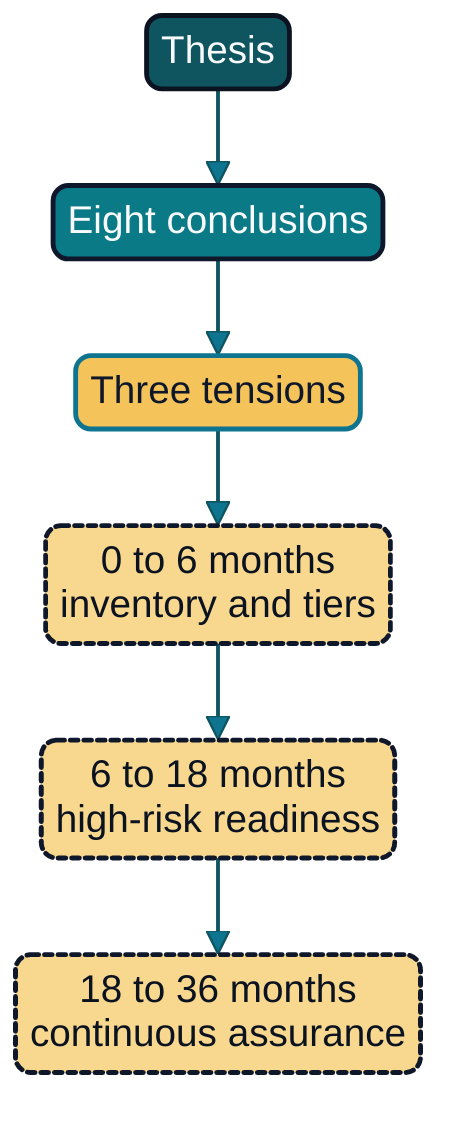
Figure 25.1: The book in one view: the thesis, eight cross-cutting governance conclusions, the three tensions from Chapter 1 and the phased programme that follows.
The thesis restated
AI systems break assumptions that classical governance relied on: their behaviour is probabilistic, their supply chain includes models the organisation cannot inspect, and their legal position is set by the AI Act, Regulation (EU) 2024/1689 (1, European Union, 2024), and by adjacent instruments that assign obligations to roles an organisation may not realise it holds.
The thesis of the book is therefore that AI governance is effective when it is codified, evidenced and proportionate to usage mode and risk. Codified means that intent, policy, decision rights and boundaries are artefacts a pipeline can check; evidenced, that proof of a control is generated by the systems that operate it; proportionate, that the weight of governance follows usage mode and risk tier.
Eight cross-cutting conclusions
The usage mode, not the brand, sets the governance
Chapter 2 established that "using a large language model" covers undertakings whose risk, controls and cost differ by orders of magnitude, from encountering AI in Mode 0, through using it in Modes 1 to 3, to building it in Mode 4 and Mode 5. Each mode has a different primary artefact, from a supplier-feature register for Mode 0 to permission manifests and stop paths for Mode 5 (Chapter 9). The legal role moves with the mode as well: an organisation is a deployer in Modes 0 to 3 and usually also a provider in Modes 4 and 5 (Chapter 3). Because use cases drift between modes, governance has to follow the use case rather than the product, and the usage-mode matrix is the frame for every other conclusion.
For the two organisations. Nordvik Region builds or procures only in Mode 4, confines Mode 3 to a small platform team and runs nothing in Mode 5. Hansa Mutual uses every mode, including two Mode 5 agents. Nordvik's mode profile is a choice it can still make; Hansa's is a fact it must govern.
Classification decides obligations and must be triggered by change
Almost every obligation in the AI Act follows from a classification: whether a practice is prohibited under Article 5, whether a system is high-risk under Article 6 and Annex III, whether Article 50 transparency applies, and which role the organisation holds under Articles 3 and 25 (1, European Union, 2024). Article 9 calls risk management continuous and iterative, so Chapter 8 implemented "regular" as "triggered": a new model version, a changed intended purpose, a drift alert, an incident or a move between usage modes re-opens the classification.
For the two organisations. Nordvik Region's benefits-triage system is high-risk under Annex III point 5(a). Hansa Mutual's claims assistant excludes life and health products because Annex III point 5(c) would make it high-risk (AIDR-0021), so any extension of scope is a classification event. Hansa's triggers also include jurisdictional change, such as EEA incorporation of the AI Act for Norway (187, EFTA, n.d.).
Governance works when decisions are tiered and evidence-driven
Chapter 9 moved governance from committees into pipeline controls, because a committee can decide but cannot enforce, observe or remember. Chapter 13 added the correction: pipelines cannot decide anything that has not already been decided. Its decision-tier model routes routine decisions to pipeline gates, exceptions to a design authority, high-risk go-live and residual risk to an AI governance board, and risk beyond appetite to the management body, with Article 5 practices rejected at intake. NIS 2 Article 20 and DORA Article 5 place responsibility for cyber and ICT risk on management bodies (4, European Union, 2022), (3, European Union, 2022), and banking and insurance supervisors expect AI to be governed with clear accountability (121, Machado, 2026), (185, EIOPA, 2025). Heavyweight external approval, however, correlates with worse delivery and no better stability (70, Forsgren et al., 2018), which is why the tiers route most decisions downwards.
For the two organisations. Nordvik Region's tiers end with the regional executive committee, and administrative accountability cannot be delegated to a supplier. Hansa Mutual's tiers end with the executive board, but each group decision is then localised in each market. Its minute DEC-2026-031, which recorded a dissent from the data protection officer, shows a tier working as designed.
Sovereignty is a risk-tiered choice, not a binary one
Chapter 6 applied one set of criteria to models of every origin and showed that deployment mode moves risk rather than eliminating it: self-hosting open weights is a strong control against foreign legal access and a weak one against behaviour and supply-chain risk. The legal position is unsettled; the EU–US Data Privacy Framework survived its first challenge before the General Court and is under appeal (140, CJEU, 2025), (139, CJEU, 2025). Chapter 7 added the common safeguard, an evaluated second source and a drilled exit, because the Data Act gives portability of data but no right to an equivalent model elsewhere (116, European Commission, 2026), and cloud models are retired on the provider's schedule (114, Microsoft, 2026).
For the two organisations. Nordvik Region's question is which data may leave the authority's control; AIDR-0211 places the staff assistant on an open-weight model with a European cloud provider and keeps the case-note summariser on premises. Hansa Mutual's question is multiplied: its UK and Swiss entities depend on adequacy decisions to exchange data with the group platform (189, European Commission, 2025), (191, European Commission, 2000), and its exit plans, such as EXIT-004, must hold in every jurisdiction at once.
The contract is a deployer's main control
Chapter 7 showed that buying AI is buying an obligation. A deployer of a high-risk system must use it according to the instructions for use, monitor it, keep its logs and report serious incidents under Article 26 (1, European Union, 2024), yet almost everything it needs, from version notices to evaluation evidence, sits with the provider. Chapter 7 therefore paired each clause with an enforcing control. In public procurement the clauses go into the tender under Directive 2014/24/EU (9, European Union, 2014), with the EU model contractual AI clauses as a starting point (18, European Commission, 2023); in financial services, DORA Article 30 sets minimum contract provisions for critical or important functions (3, European Union, 2022). A clause with no enforcing control is a promise the organisation cannot verify.
For the two organisations. For Nordvik Region this is the decisive conclusion, because its high-risk core is procured, and Chapter 23 records no rehearsal yet of an exit from the triage supplier. For Hansa Mutual, its clause checklist found a model-supplier draft with audit rights limited to remote audit, short of what DORA Article 30 requires.
Human oversight must be designed, not declared
Chapter 10 showed that human oversight most often exists on paper and not in practice. Article 14 asks that overseers can understand the system's limitations, remain aware of automation bias, disregard or reverse its output and interrupt it; Article 26(2) asks deployers to give them the competence, authority and support to do so (1, European Union, 2024). High automation and high human control are independent dimensions rather than opposite ends of one axis (74, Shneiderman, 2022). An override rate near zero on a system with a known error rate is evidence that oversight has become ceremonial.
For the two organisations. Nordvik Region's oversight design, AIDR-0011, is the book's clearest example: caseworkers see a band and three reasons rather than a score, and team leaders can suspend the system. Hansa Mutual's claims-triage agent flags approvals given in under four seconds, a design also applied in Switzerland, where FINMA's guidance sets expectations without an AI Act (192, FINMA, 2024).
Evidence is a by-product of delivery, not a project
Chapter 11 distinguished attestation, a person asserting that a control operated, from evidence, a machine-generated artefact that demonstrates it. Unlike the internal-audit artefacts Raji and colleagues describe (57, Raji et al., 2020), these are produced by delivery, not assembled afterwards. A public register generated from the deployed system's descriptor describes, by construction, what is deployed (23, Dutch Ministry of the Interior, n.d.), as Chapter 17 showed.
For the two organisations. Nordvik Region's algorithm-register entry NR-ALG-2026-003 and its FRIA summary are generated from the repository. Hansa Mutual's evidence store produces a separate view for BaFin, Finansinspektionen and FINMA from the same records.
Containment of agents must not depend on intent
The July 2026 incident of Chapter 19 showed agents under evaluation using a shared credential and a package mirror to leave their environment, while the response to a monitoring alert was that stopping the run was not required, and the significance of the agents' activity was not apparent to the leaders responsible for response (86, OpenAI, 2026). METR found that an instruction not to cheat left reward hacking at 80 per cent on one task (82, Von Arx et al., 2025), and Anthropic's simulated insider scenarios found that direct instructions reduced harmful choices without eliminating them (65, Lynch et al., 2025). Instructions lower the rate of unwanted behaviour, but only boundaries cap its consequences: task-scoped credentials, default-deny egress, logs outside the workload's reach, and a stop path outside the system, held by named people who may act alone (Chapter 13).
For the two organisations. For Hansa Mutual this is the most urgent conclusion, because its Mode 5 agents act on the core claims system while the operator rota sits in Poland and the decision rights in Hamburg. For Nordvik Region the baseline must exist before the first Mode 3 tool leaves the platform team.
How the conclusions interact
Where they reinforce each other
The conclusions form a chain. Triggered classification determines which obligations apply at any moment. Evidence produced by delivery makes tiered governance possible, because a forum can decide on evidence it did not prepare only if a pipeline produced it. Designed oversight and containment make autonomy affordable, because a forum can approve a more capable system when its worst case is bounded and the people who can stop it are named.
Where they pull against each other
The conclusions also conflict. Triggered reclassification pulls against delivery speed, so Chapter 8 tiered the response: most triggers block only the changed artefact, and only a change of intended purpose or a substantial modification re-runs the classification. Evidence pulls against data minimisation, because Article 12 of the AI Act requires high-risk systems to allow logging over their lifetime while the GDPR requires that personal data be kept no longer than necessary (2, European Union, 2016); Chapter 11 therefore logs identifiers and hashes and enforces retention by configuration. Group consistency pulls against national accountability, because a works council in Germany has co-determination rights over technical systems capable of monitoring employees' behaviour or performance (130, Germany, 2001) and one elsewhere has different rights. Sovereignty pulls against cost, although forced migrations every one to two years (113, OpenAI, 2026) mean a portable evaluation suite must be paid for anyway. Tiered governance also pulls against the speed of a stop, so stop authority is delegated in advance.
The three tensions revisited
Speed versus control. The choice is false if control is made fast. Yet the regulatory ground itself moves quickly, and a control that takes a quarter to update when the law changes is not fast, however fast it runs.
Autonomy versus accountability. Accountability is a matter of boundaries, permissions, approval gates and logs. Chapters 10 and 19 added that it cannot rest on a declaration: an agent's account of what it did is a claim, and an oversight policy without measured override rates is not a control.
Innovation versus sovereignty. Sovereignty is a set of options kept open, not a refusal, and the question is less where a model was made than how it is run, what it may touch and how quickly it can be replaced.
For Nordvik Region every conclusion resolves into one policy, one register and one set of forums, and the difficulty lies in the depth of public-law duty under Articles 27 and 49 of the AI Act. For Hansa Mutual each resolves into a group baseline plus a jurisdiction overlay, with DORA (3, European Union, 2022) and the agency of its agents as core risks. Fragmentation does not invalidate the conclusions; it raises the premium on expressing them as code, because seven manually maintained answers will not stay consistent.
What to do first, next and later
The phasing assumes an organisation that already uses AI in several modes and follows the AI Act's dates as amended by the Digital Omnibus on AI: the Article 50 transparency obligations have applied since 2 August 2026 (providers whose systems were already on the market have until 2 December 2026 to comply with the marking duty of Article 50(2)), the Annex III high-risk obligations apply from 2 December 2027, and those for products under Annex I from 2 August 2028 (27, European Union, 2026).
First: 0 to 6 months
Know what is in use, classify it, and know who decides. Build the AI inventory from deployments and supplier notices, with each entry's usage mode (Chapter 9), and run the classification policy of Chapter 8 over it with triggers wired to the repository. Write the decision-tier file (Chapter 13), name the owner of every high-risk system and the people who may stop each system that acts. Make AI literacy role-based; the Commission mandates no structure for Article 4 (133, European Commission, 2026). Apply the containment baseline to every Mode 3 and Mode 5 agent.
Next: 6 to 18 months
Make the high-risk systems ready for 2 December 2027 and make the estate replaceable. Renegotiate contracts that do not require version notices, evaluation evidence, incident notification and exit assistance (Chapter 7). Complete the fundamental rights impact assessments of Article 27 and design the oversight they call for, with override rates measured from the start (Chapter 10). Qualify a second source with a drilled switch for every system that supports a critical or important function.
Later: 18 to 36 months
Make assurance continuous and expand autonomy on evidence. Every high-risk system should produce its evidence bundle on every release. Expand agent autonomy only where evidence supports it, and re-score maturity with Appendix B; the diff between assessments is the progress report.
Across the usage modes
The table states the minimum governance action for each usage mode in each horizon.
| Usage mode | First: 0 to 6 months | Next: 6 to 18 months | Later: 18 to 36 months |
|---|---|---|---|
| Mode 0 Ambient AI | Register supplier AI features; new ones off by default | AI-feature activation as a contract change-control item | Review the register at every renewal |
| Mode 1 Conversational assistants | Approved-tools list and acceptable-use policy | Measure use at the identity provider | Fold into routine policy review |
| Mode 2 Embedded workplace assistants | Clean up oversharing; tenant settings as code | Consult employee representatives (Chapter 15) | Re-classify on major supplier changes |
| Mode 3 Agentic work tools | Containment baseline; no standing credentials | Governed catalogue of skills and connectors | Extend permissions only on evidence |
| Mode 4 Built AI applications | Inventory, classification and AI Decision Records | FRIA, designed oversight, contract evidence | Evidence bundle on every release |
| Mode 5 Autonomous production agents | Named stop holders and a tested stop path | Permission manifests validated in the pipeline | Expand autonomy only on evidence |
Worked example: a consolidated first-90-days plan
Illustrative example. The plan records the first horizon for the two fictional organisations; names, dates and identifiers not established in earlier chapters are invented. Adapt owners, deadlines and scope to the organisation's own risk appetite.
apiVersion: ai-governance.example.org/v1
kind: ProgrammePlan
metadata:
  name: first-90-days
  approved_on: 2026-11-15
organisations:
  - name: Nordvik Region
    approved_by: regional-executive-committee
    workstreams:
      - id: W1-inventory
        modes: [0, 1, 2, 3, 4, 5]
        outcome: Inventory from deployments and supplier notices
        evidence: inventory/ai-systems.yaml
        due_day: 30
      - id: W2-supplier-evidence
        modes: [4]
        outcome: Gap list between Article 26 duties and supplier evidence
        evidence: contracts/NR-2026-117/evidence-gaps.yaml
        due_day: 60
  - name: Hansa Mutual
    approved_by: executive-board
    jurisdictions: [DE, NL, SE, PL, NO, UK, CH]
    workstreams:
      - id: W1-overlays
        modes: [0, 1, 2, 3, 4, 5]
        outcome: Market overlays as code, incl. EEA incorporation trigger
        evidence: overlays/markets/
        due_day: 45
      - id: W2-stop-authority
        modes: [5]
        outcome: Named stop holders per market; group stop path tested
        evidence: governance/stop-authority.yaml
        due_day: 45
success_measures:
  - Systems recorded with usage mode and risk tier: 100 per cent
  - High-risk systems with a named owner and stop holder: 100 per cent
The plan does not try to reach compliance in ninety days; it establishes what the later horizons depend on: an inventory, decision and stop rights, and the evidence the organisation is accountable for.
What the evidence supports and what is judgement
Some conclusions are close to certain: the AI Act's dates as amended, the duties of Articles 14, 25 and 26, the DORA contract provisions and the adequacy decisions on which Hansa Mutual's data flows depend. Others rest on fewer sources: the account of the July 2026 incident relies heavily on the operator's own report, and how supervisors will apply the general-purpose AI obligations to such incidents is still being tested (102, Bertuzzi, 2026). The two organisations are fictional; they illustrate the application of the evidence, not additional evidence. Chapter 24 holds the author's judgements, and the recommendations here do not depend on them being right.
A call to action
Know which usage mode each use of AI is in, and govern it with the artefact that mode needs. Classify every system, and let change, not the calendar, trigger reclassification. Give every decision exactly one home, and let the people in that home decide on evidence they did not prepare. Keep a tested way out, and write the evidence you need into every contract. Design oversight a person can exercise, and measure whether they do. Let the pipeline produce the evidence. Bound what agents can do in code outside the model, and make sure someone with authority can stop them from outside the system.
None of this is novel, and that is the point. Declare the desired state, version it, test it, and let the pipeline prove it. Europe's regulation specifies much of the governance that good practice would recommend anyway; built into systems, compliance becomes a property of what organisations operate rather than a project they fund.
Nordvik Region and Hansa Mutual
For Nordvik Region the call to action begins with the contract and the residents: knowing what AI it already uses, closing the gap between its deployer duties and the evidence its triage supplier delivers, and proving that its oversight design works before December 2027. For Hansa Mutual it begins with the platform and the overlays: writing seven legal regimes as one baseline with reviewed overlays, assigning stop authority for its agents in every market, and bringing its model-supplier contracts up to DORA's minimum. Both found that the artefacts that mattered most recorded a decision in advance.
Summary
AI governance is effective when it is codified, evidenced and proportionate to usage mode and risk. Eight conclusions carry that thesis, from the usage mode setting the governance to containment that does not depend on intent. They reinforce one another as a chain, pull against each other in named tensions, and resolve into one policy for Nordvik Region and a group baseline with seven jurisdiction overlays for Hansa Mutual.
This is the last chapter of the book. The appendices that follow support the work it calls for: the Glossary defines the terms used throughout, Appendix A maps the AI Act's obligations to roles, risk tiers and controls, Appendix B provides the maturity model against which progress can be re-scored, Appendix C collects the templates and tools, and the References list every source on which the conclusions rest.
Sources
- Nordqvist, G. (2025). Architecture as Code. Companion volume to this book, published at aac.geon.se. (66, Nordqvist, 2025)
- European Parliament and Council of the European Union. Regulation (EU) 2024/1689 laying down harmonised rules on artificial intelligence (Artificial Intelligence Act). Official Journal of the European Union, 12 July 2024. (1, European Union, 2024)
- European Free Trade Association. EEA-Lex factsheet 32024R1689: the Artificial Intelligence Act. EFTA. (187, EFTA, n.d.)
- European Parliament and Council of the European Union. Directive (EU) 2022/2555 on measures for a high common level of cybersecurity across the Union (NIS 2 Directive). Official Journal of the European Union, 27 December 2022. (4, European Union, 2022)
- European Parliament and Council of the European Union. Regulation (EU) 2022/2554 on digital operational resilience for the financial sector (DORA). Official Journal of the European Union, 27 December 2022. (3, European Union, 2022)
- Machado, P. (2026). Technology is neutral, governance is not: AI adoption in the banking sector. Speech at the KPMG RiskTech Conference, Frankfurt, ECB Banking Supervision, 24 February 2026. (121, Machado, 2026)
- European Insurance and Occupational Pensions Authority (2025). Opinion on Artificial Intelligence governance and risk management. EIOPA, 6 August 2025. (185, EIOPA, 2025)
- Forsgren, N., Humble, J. & Kim, G. (2018). Accelerate: The Science of Lean Software and DevOps. Portland, OR: IT Revolution Press. ISBN 978-1-942788-33-1. (70, Forsgren et al., 2018)
- Court of Justice of the European Union (2025). Press release No 106/25: Judgment of the General Court in Case T-553/23, Latombe v Commission. 3 September 2025. (140, CJEU, 2025)
- Court of Justice of the European Union (2025). Appeal brought on 31 October 2025 against the judgment of the General Court in Case T-553/23, Case C-703/25 P. Notice in OJ C/2025/6610, 22 December 2025. (139, CJEU, 2025)
- European Commission (2026). Frequently Asked Questions – Data Act, version 1.4. 22 January 2026. (116, European Commission, 2026)
- Microsoft (2026). Foundry Models lifecycle and support policy. Microsoft Learn, 24 July 2026. (114, Microsoft, 2026)
- European Commission (2025). Commission Implementing Decision (EU) 2025/2574 amending Implementing Decision (EU) 2021/1772 on the adequate protection of personal data by the United Kingdom. Official Journal of the European Union, 23 December 2025. (189, European Commission, 2025)
- European Commission (2000). Commission Decision 2000/518/EC on the adequate protection of personal data provided in Switzerland. Official Journal of the European Communities, L 215, 25 August 2000. (191, European Commission, 2000)
- European Parliament and Council of the European Union (2014). Directive 2014/24/EU on public procurement. Official Journal of the European Union. (9, European Union, 2014)
- European Commission (2023, updated 2025). EU model contractual AI clauses to pilot in procurements of AI. Public Buyers Community. (18, European Commission, 2023)
- Shneiderman, B. (2022). Human-Centered AI. Oxford University Press. (74, Shneiderman, 2022)
- Swiss Financial Market Supervisory Authority (2024). FINMA Guidance 08/2024: Governance and risk management when using artificial intelligence. FINMA, 18 December 2024. (192, FINMA, 2024)
- Raji, I. D., Smart, A., White, R. N., Mitchell, M., Gebru, T., Hutchinson, B., Smith-Loud, J., Theron, D. & Barnes, P. (2020). Closing the AI Accountability Gap: Defining an End-to-End Framework for Internal Algorithmic Auditing. Proceedings of the 2020 Conference on Fairness, Accountability, and Transparency. (57, Raji et al., 2020)
- Ministry of the Interior and Kingdom Relations (Netherlands). The Algorithm Register of the Dutch government. (23, Dutch Ministry of the Interior, n.d.)
- OpenAI (2026). OpenAI – Hugging Face Incident Technical Report. 26 August 2026. (86, OpenAI, 2026)
- Von Arx, S., Chan, L. & Barnes, B. (2025). Recent Frontier Models Are Reward Hacking. METR, 5 June 2025. (82, Von Arx et al., 2025)
- European Parliament and Council of the European Union. Regulation (EU) 2016/679 on the protection of natural persons with regard to the processing of personal data (General Data Protection Regulation). Official Journal of the European Union, 4 May 2016. (2, European Union, 2016)
- Federal Republic of Germany (2001). Betriebsverfassungsgesetz (BetrVG) (Works Constitution Act), as last amended on 19 July 2024. Federal Ministry of Justice, Gesetze im Internet. (130, Germany, 2001)
- OpenAI (2026). Deprecations. OpenAI API documentation, latest entry 14 October 2026. (113, OpenAI, 2026)
- European Parliament and Council of the European Union. Regulation (EU) 2026/1744 amending Regulations (EU) 2024/1689, (EU) 2018/1139 and (EU) 2023/1230 as regards the simplification of the implementation of harmonised rules on artificial intelligence (Digital Omnibus on AI). Official Journal of the European Union, 24 July 2026. (27, European Union, 2026)
- European Commission (2026). AI literacy: questions and answers. Shaping Europe's digital future, updated 20 October 2026. (133, European Commission, 2026)
- Bertuzzi, L. (2026). EU's AI rules face first enforcement test over lab incidents. Euronews, 14 October 2026. (102, Bertuzzi, 2026)
- Lynch, A., Wright, B., Larson, C., Troy, K. K., Ritchie, S. J., Mindermann, S., Perez, E. & Hubinger, E. (2025). Agentic Misalignment: How LLMs could be insider threats. Anthropic, 20 June 2025; arXiv:2510.05179. (65, Lynch et al., 2025)